
Ford AdBlue Reset and System Malfunction: Transit, Custom, Ranger, Kuga and Focus
Ford AdBlue Reset and System Malfunction: Transit, Custom, Ranger, Kuga and Focus
On this page
- Which Ford models have AdBlue?
- Ford AdBlue warning light and messages
- The "No engine start in XXXX km" countdown
- Where the filler is and how much to add
- Why AdBlue runs out fast
- AdBlue system malfunction with a full tank
- Ford AdBlue fault codes
- How to reset an AdBlue malfunction
- Which tool does what: VCM 2, FDRS, FORScan
- AdBlue, DPF and EGR warnings compared
- Frequently asked questions
Which Ford models have AdBlue? Transit, Custom, Courier, Ranger, Everest, Focus, Kuga
AdBlue is the fluid for the SCR system that turns nitrogen oxides (NOx) in the exhaust of Ford's Euro 6 diesels into nitrogen and water vapour; not every Ford diesel has it. In 2016 Ford announced the 2.0 EcoBlue as its first SCR application in Europe. At the same time it said the 1.5 EcoBlue would come with either SCR or a lean NOx trap (LNT), depending on vehicle weight and load. So the same model name can cover versions with and without AdBlue.
The engine name alone does not settle it either. In Ford's handbook for Courier vans built from October 2020, the SCR section is written for an engine called the 1.5 Duratorq TDCi. The quickest check is physical: if there is a second filler with a blue cap next to the fuel filler, the vehicle has AdBlue.
| Model | Diesel engine | AdBlue | Tank (Ford document) |
|---|---|---|---|
| Transit (2016 on) | 2.0 EcoBlue | Yes | 24 litres (handbook for October 2020 to April 2021 builds) |
| Transit Custom, Tourneo Custom (Kocaeli-built) | 2.0 EcoBlue | Yes | 22 litres (handbook for October 2020 to April 2021 builds) |
| Transit Courier, Tourneo Courier (2014 to 2023 generation) | 1.5 Duratorq TDCi | Yes on builds from October 2020 | About 11.9 litres (2021 handbook) |
| New Transit Courier (2024 on) | 1.5 EcoBlue 100 PS | Yes | 13.3 litres (Ford technical specification) |
| Transit Connect, Tourneo Connect (2019 facelift on) | 1.5 EcoBlue | Depends on version; look for the blue cap | In the vehicle's handbook |
| New Tourneo Connect, Transit Connect (2022 on) | 2.0 TDI (Volkswagen Caddy based) | Volkswagen system | Volkswagen logic applies |
| Ranger (EcoBlue, 2018 on), Everest | 2.0 EcoBlue, single and twin turbo | The 2.0 EcoBlue is the engine Ford introduced with SCR | In the vehicle's handbook |
| Focus (4th generation, 2018 on) | 1.5 and 2.0 EcoBlue | SCR on the 2.0; depends on version for the 1.5 | In the vehicle's handbook |
| Kuga, Puma | 1.5 EcoBlue; Kuga also 2.0 EcoBlue | Depends on engine; look for the blue cap | In the vehicle's handbook |
| Mondeo, S-Max, Galaxy | Euro 6 TDCi, 1.5 and 2.0 EcoBlue | Depends on engine; look for the blue cap | In the vehicle's handbook |
The litre figures come from Ford's handbooks and technical specification sheet; where the table says "in the vehicle's handbook" we could not reach a Ford document and did not guess. In your own handbook the AdBlue tank has its own line under "Capacities and Specifications". The new Connect is a Ford-badged Volkswagen Caddy, so for its messages and service routines the Volkswagen AdBlue failures article applies. Once you have found the blue cap, the next question is which family the message on the display belongs to.
Ford AdBlue warning light and display messages: what do they mean?
The Ford AdBlue warning light is the selective catalytic reductant (SCR) system warning lamp, and the same lamp comes on for a low level and for a system fault. The message in the information display tells the two apart. Ford's rule is clear: if the lamp comes on while the vehicle is moving and the fluid level is sufficient, it is a system malfunction.
| Display message | Meaning | Action |
|---|---|---|
| AdBlue low Range: XXXX km Refill soon | Level is dropping; approximate distance before the tank is empty | Refill soon |
| AdBlue low No engine start in XXXX km | Level countdown has started | Refill; when the counter ends the engine will not restart once switched off |
| AdBlue level empty. Refill to start engine | Tank empty | No restart without a refill; the minimum quantity is shown in the display |
| AdBlue system malfunction Service required (Custom: "AdBlue sys malfunction") | SCR system fault | Read the codes; a refill does not clear this message |
| AdBlue system No engine start in XXXX km | Countdown caused by a fault | Repair before the counter ends |
| AdBlue system Service required to start engine | Fault lock-out active | No restart until the fault is fixed; then read and clear the codes with a tool |
The messages are quoted as they appear in Ford's 2020–2021 Transit, Custom and Courier handbooks. The display may abbreviate them; the word that matters is "low" versus "system". Pressing OK removes the message from the screen, but it returns while the cause remains.
Ford Transit AdBlue level check: according to the Transit and Custom handbooks, use the steering wheel controls to select Settings, then Vehicle maintenance, then DEF level; the approximate gauge sits under DEF gauge. On the Courier the path is Settings, Information, AdBlue. DEF is the North American name for AdBlue (diesel exhaust fluid), and the Tourneo Custom and Tourneo Courier follow the menus of their Transit siblings.
On the Focus, Kuga and Puma the location of the AdBlue gauge depends on the instrument cluster; searching the handbook for "AdBlue" or "DEF" is the fastest way. Once you know which message you have, the pressure comes from the counter.
"No engine start in XXXX km": how the Ford AdBlue countdown works
The countdown is the driver inducement system required by the Euro 6 rules: when the counter reaches zero, the engine will not restart once it has been switched off. Under Annex XVI of EU Regulation 2017/1151, the low-level warning must start at least 2,400 km before the tank runs empty. The manufacturer may instead choose the level equal to 10% of tank capacity or 150% of the average range on a full fuel tank, whichever comes earlier. Ford's handbooks do not state at what distance the first warning appears; they only show the remaining distance on the display.
The warning may be intermittent at first, becomes continuous as the lock-out approaches and, under the regulation, cannot be turned off until the reagent has been replenished. Restarts made by the start-stop system do not count toward the countdown. The Courier handbook adds one detail: if the tank freezes at a low level, the remaining distance shown may drop.
On the fault side the counter starts under a different rule. If incorrect fluid is detected or dosing is interrupted and the problem is not fixed within 50 km of the warning, the same inducement applies. A deviation of more than 50% between average and demanded AdBlue consumption over 30 minutes also triggers the warning. The lock-out lifts only when enough fluid is added or the fault is repaired; a vehicle that is already running does not stop by itself.
The cheapest way out of the lock-out is a correct refill, and Ford sets a few conditions here too.
Where is the Ford AdBlue filler, how do you refill and how much is needed?
On Ford vehicles the AdBlue filler sits next to the fuel filler and has a blue cap; the Transit, Custom and Courier handbooks say so in the same sentence. Ford Ireland's support page adds that on some vehicles it sits under the diesel cap and is labelled. On the Focus, Kuga and Puma the first place to look is also behind the fuel flap.
- Correct fluid: only AdBlue certified to ISO 22241. Ford's rules: do not dilute with water or any other liquid, do not put it in the fuel tank, do not re-use an empty container.
- From a pump: insert the nozzle fully; it shuts off when the tank is full. Raise it slightly, remove it slowly, then turn the cap clockwise until it clicks.
- From a container: use a container with a sealed spout. Insert the spout until the seal seats in the filler pipe; when the flow stops, the tank is full.
- After running empty: the Custom handbook asks for at least 5.7 litres to restart the engine and warns that more may be needed on a gradient. On the Transit and Courier the required quantity is shown in the information display. After filling from empty, the new level may take a short time to register.
- Wrong fluid added: Ford's instruction is not to start the engine and to have the vehicle checked; damage from incorrect fluid is not covered by the warranty.
AdBlue freezes below −11 °C; Ford vehicles have a preheating system that lets the fluid work below that temperature. Do not brim the tank in cold weather: Ford warns that an overfilled tank whose fluid freezes may suffer damage not covered by the warranty. Do not keep containers in the vehicle or in direct sunlight; Ford recommends storage between −5 °C and 20 °C. Ammonia vapour can escape when the cap is opened, so refill in a well-ventilated area.
If the tank still empties quickly after a correct refill, the issue is consumption.
Why does AdBlue run out fast and how far does a tank last?
According to Ford, AdBlue consumption is between 1% and 5% of fuel consumption and varies with driving style, high speed, stop-start driving, air conditioning, accessories, payload and towing. A van using 9 litres of diesel per 100 km would therefore use between 0.09 and 0.45 litres of AdBlue per 100 km. On that basis a 24-litre Transit tank lasts roughly 5,300 to 26,700 km. Ford also notes that consumption is specified for a vehicle variant, not for a single vehicle.
If the tank empties faster than expected, look for an external leak first: white crystal deposits under the tank, at line joints and around the dosing valve in the exhaust point to one. The system also monitors consumption itself; the 50% deviation rule above logs over-dosing and under-dosing as a fault. The general logic of AdBlue faults is covered in AdBlue failure causes and reset procedures. That fault log leads to the warning that will not go out with a full tank.
Ford Transit AdBlue system malfunction: tank full but the warning stays on
An AdBlue light with a full tank is, by Ford's definition, a system malfunction rather than a level issue, and adding fluid will not clear it. On the Transit, Transit Custom, Courier and Ranger the cause is usually in one of the six places below. They are listed in order of how easy they are to check.
- Fluid quality. Diluted or contaminated AdBlue sets a quality code (P207F) or a high NOx code (P2BA9). Fresh fluid will not fix it until the tank has been drained and cleaned.
- NOx sensors. There is one sensor upstream and one downstream of the SCR catalyst; the downstream sensor measures how well the catalyst works. An ageing sensor keeps its power supply and bus communication but starts reporting implausible values. A new sensor needs a teach-in or initialisation after replacement.
- Dosing valve and mixer. Mostly short trips and over-dosing leave AdBlue crystals that block the valve and the catalyst inlet. An SCR efficiency code (P20EE) on its own rarely means the catalyst itself has failed; dosing system codes are almost always present as well.
- Pump and purge cycle. Ford's handbook says the SCR pump runs for a short time after the engine is switched off and that this is normal. If that purge is cut short, crystals form in the pump and it can seize. The question most often skipped is whether the vehicle is isolated at the battery switch the moment the ignition goes off.
- Heater. AdBlue freezes at −11 °C; with an open heater circuit (P20B9) the warning appears on cold mornings. In many SCR systems the pump, heater and level sensor are combined in one module inside the tank.
- Wiring, connectors and temperature sensor. Corrosion and breaks at connectors are a known cause of intermittent warnings. An exhaust gas temperature sensor fault (for example P2033) is also among the causes of an SCR efficiency code.
Software is not ruled out either. When sensors and dosing check out and an efficiency or quality fault keeps returning, check whether the engine control software is up to date; on Ford, control unit software updates are done with IDS or FDRS and a VCM 2. The same list covers Transit Custom AdBlue problems, since the Custom uses the same 2.0 EcoBlue engine. Before replacing parts on a guess, read what the code says.
Ford AdBlue fault codes and first checks
Ford's AdBlue codes are the generic SAE P20xx, P22xx and P2Bxx codes, and they mean the same on every make. Ford software and FORScan may also show a code in the form PXXXX:00-2F. The part after the colon describes the fault sub-type and status; the core meaning is in the first five characters.
| Code | Meaning | Check first |
|---|---|---|
| P203F | Reductant level low | Tank level, level sensor |
| P20E8 | Reductant pressure too low | Pump, heater, line leak or blockage, fluid level |
| P208A | Reductant pump control circuit open | Pump connector and supply |
| P2047 | Reductant injector (dosing valve) circuit open | Valve connector and wiring at the exhaust |
| P20F6 | Reductant injection valve stuck open | Crystals in the valve, the valve itself |
| P20B9 | Reductant heater A control circuit open | Heater circuit and connector |
| P207F | Reductant quality performance | Fluid quality; drain and clean the tank |
| P20EE | SCR NOx catalyst efficiency below threshold | Dosing side, NOx sensors, crystals |
| P2BA9 | NOx exceedance: insufficient reagent quality | Fluid quality |
| P2BAD | NOx exceedance: root cause unknown | Read together with the other codes |
| P2200 / P2201 / P2202 | NOx sensor 1 circuit / range / low input | Upstream NOx sensor |
| P229F | NOx sensor 2 range / performance | Downstream NOx sensor |
| P2033 | Exhaust gas temperature sensor 2 (bank 1) circuit high | Sensor and wiring |
A code does not pinpoint the failed part; it tells you which component to check first. If P20EE comes with P20E8 or P2047, start on the dosing side; if P229F is the only code, start with the downstream sensor. With the codes in hand, the next job is to confirm the cause, not to clear them.
How to reset a Ford Transit AdBlue malfunction with a diagnostic tool
An AdBlue malfunction reset means clearing the code after the cause has been fixed and resetting the learned values of any replaced part. A code cleared while the cause remains comes back at the system's next self-test, and the lock-out lifts only once the fault is repaired. This is what most searches for "Ford Transit AdBlue malfunction reset" miss.
- Support the battery and read the codes. Record every code and the freeze frame data in the engine control module (PCM) and, where fitted, in a separate AdBlue control unit.
- Check live data. Watch both NOx sensor values, AdBlue pressure, tank level and temperature. The check Hella describes for NOx sensors: for at least 15 minutes at a steady 100 km/h or so, with the SCR catalyst above 180 °C, the upstream sensor always reads higher and the conversion rate is around 60–90%.
- Run the active test. The SCR dosing test in IDS and FDRS, or the actuator test of a multi-brand scanner, shows whether the pump and dosing valve respond to commands.
- Fix the cause. Fluid, sensor, valve, pump, heater or wiring. Crystal deposits can be cleaned; a damaged valve or pump is replaced.
- Clear the code and run the service function. After a NOx sensor replacement, run the sensor reset or teach-in; after a dosing valve, tank or pump module replacement, run the matching adaptation; for a recurring fault, reset the SCR learned values. Menu names vary by tool and model.
- Road test and read again. The system completes its self-test within a drive cycle. Read the codes again after the drive; the "Service required to start engine" lock-out lifts only once the fault is fixed.
Ford vehicles built before 2018 run on IDS, those from 2018 on FDRS; both need Ford's own subscription. The table below shows how far each tool can take the same job.
Which tool for a Ford AdBlue reset: VCM 2, IDS/FDRS, FORScan or a multi-brand scanner
Three levels of tool handle AdBlue work on a Ford: Ford's own software, independent Ford-specific software and a multi-brand diagnostic scanner. The depth of the job decides which one is enough. Reading codes and resetting a sensor is a scanner job; updating control unit software needs Ford's software.
| Tool | What it does on the AdBlue side | Limit |
|---|---|---|
| Ford VCM 2 with IDS and FDRS | Dealer-level diagnostics, AdBlue reset, SCR dosing test, DPF regeneration, control unit software update | Subscription bought from Ford; most FDRS operations need an internet connection |
| FORScan with a suitable adapter | Reads Ford modules; service functions depend on the model | Independent software, not Ford's; no guarantee for 2025 and later models |
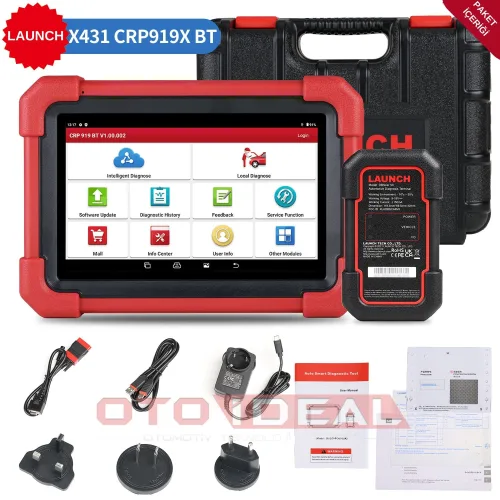
| Multi-brand scanner: Launch CRP 919X BT, Autel MaxiSys 906 MAX, Launch X431 Pro5 | Read and clear codes, live data, AdBlue reset; the CRP 919X BT and 906 MAX also offer a NOx sensor reset | No Ford-specific module programming; the function list varies by model and year |
| Basic OBD reader (ELM327 type) | Reads generic engine codes | No manufacturer service functions |
We do not sell Ford FDRS licences; Ford has no authorised FDRS reseller, and the subscription is sold only through Ford's own portal. Which vehicles go to IDS and which to FDRS, subscription terms and the VCM requirement are covered in Ford FDRS vs IDS. We install the software and pair the VCM 2 remotely through our Ford IDS and FDRS installation service; if the VCM 2 is not detected, see the VCM2 recovery mode steps. FORScan licence types and adapter choice are in our FORScan article.
When choosing a tool you also need to tell an AdBlue warning from a DPF or EGR warning, because all three show up on the same display.
Ford AdBlue, DPF and EGR warnings: what is the difference?
An AdBlue warning is about nitrogen oxides, a DPF warning is about soot in the particulate filter and an EGR fault is about exhaust gas returned to the intake. On EcoBlue diesels all three work together in the same exhaust system, so the codes should be read together. According to Ford's Transit handbook, the DPF cleans itself best at a steady 48 km/h or more for about 20 minutes. Regeneration happens every 160 to 500 km and each one lasts 10 to 20 minutes.
If the filter fills beyond the regeneration threshold, Ford's system disables regeneration itself, and from that point it is a workshop job. Some models offer manual regeneration from the information display. More on the DPF in our diesel particulate filter article, and on the EGR side in EGR faults and solutions.
- P2002 DPF efficiency below threshold
- P242F DPF restriction: ash accumulation
- P2453 DPF pressure sensor A circuit range/performance
- P2458 DPF regeneration duration
- P2463 DPF restriction: soot accumulation
- P0400 / P0401 / P0402 EGR flow malfunction / insufficient / excessive
- P0403 / P0404 EGR control circuit / range-performance
- P0405 / P0406 EGR sensor A circuit low / high
Honest warning
Ford's handbook states that the engine will not start if the SCR system is tampered with or disabled. In the EU, defeat devices that reduce emission control effectiveness are prohibited, and a diesel with missing or obviously defective emission control equipment fails its inspection; the right fix is to find and repair the cause. Clearing a code does not repair anything, it only removes the record, and the warning returns while the cause remains. On a vehicle still under warranty go to a Ford dealer first and keep the AdBlue receipts; Ford excludes damage from incorrect fluid and overfilling.
Frequently asked questions
How do I reset the AdBlue warning on a Ford Ranger or Everest?
The sequence is the same as on the Transit: fix the cause, clear the code, then run the service function for any replaced part. It can be done with a VCM 2 and IDS or FDRS, with FORScan, or with a multi-brand scanner that has an AdBlue reset function. A low-level warning needs no reset; a refill clears it.
How do I reset an AdBlue malfunction on a Ford Transit?
Read the PCM codes, confirm the cause with live data and a dosing test, and repair it: fluid quality, NOx sensor, dosing valve, pump, heater or wiring. Then clear the codes and run the adaptation for the replaced part. A refill does not clear a malfunction message.
What does "AdBlue system malfunction Service required" mean on a Ford Transit?
It means the SCR system has detected a fault that needs service, not that the tank is low. If it is not repaired, Ford shows "No engine start in XXXX km" and finally "Service required to start engine".
What are the common Ford Transit Custom AdBlue problems?
The main causes are a NOx sensor, crystals in the dosing valve, a pump or heater failure, incorrect fluid and corroded connectors. Vans used mainly on short trips are more prone to crystal build-up. The codes and live data show which one it is.
How do I reset AdBlue on a 2017 or 2018 Ford Transit?
The procedure is the same; what changes is the Ford software. Vehicles built before 2018 run on IDS with a VCM 2, later ones on FDRS; FORScan and multi-brand scanners also cover these vans, with functions that vary by model year.
Why is the Ford Kuga AdBlue warning light on?
For the same two reasons as on any Ford: a low level or an SCR fault. The display message tells you which; a "system" message needs the codes read.
How do I check the AdBlue level on a Ford Transit?
Use the steering wheel controls: Settings, Vehicle maintenance, DEF level. On the Courier the path is Settings, Information, AdBlue.
Does a Ford stop when the AdBlue runs out?
Not while it is running. When the counter reaches zero the engine keeps running, but it will not restart once switched off. The Custom needs at least 5.7 litres to restart; on the Transit and Courier the required quantity is shown in the display.
Tools that read Ford AdBlue codes, run the reset and perform the dosing test are listed under diagnostic devices; for workshops that want Ford's own software, see the Ford VCM 2. Send us the model, build year, the exact message on the display and the codes you have read through the contact form, and we will tell you before you order which tool opens which function on that Ford.
Related products
View all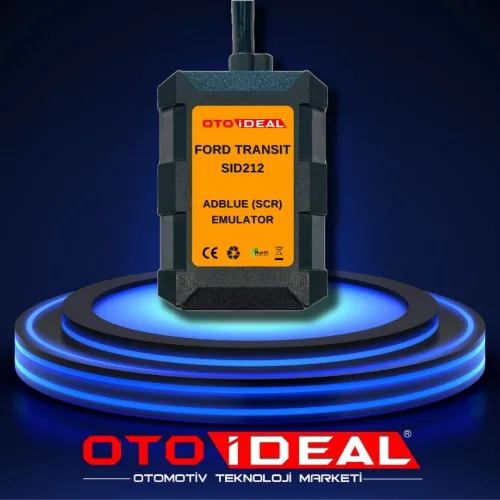
Ford Transit SID212 EVO Euro6 AdBlue Removal Emulator
Free shipping In stock, ships the same day




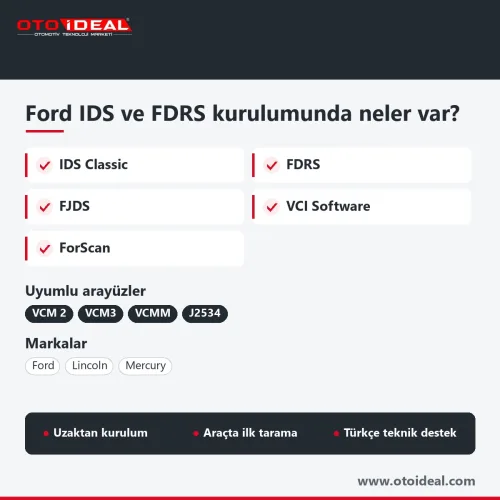
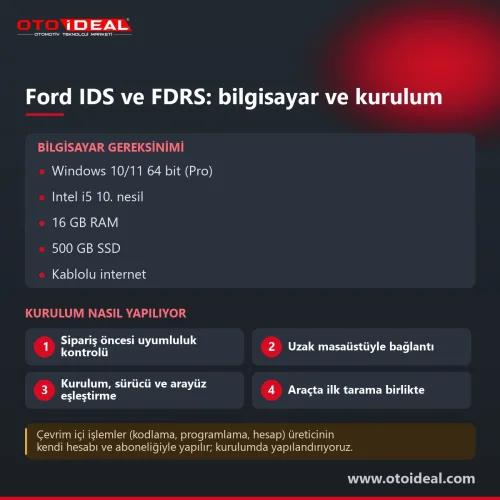
Ford IDS and FDRS Installation: VCM 2 Pairing and ForScan
No shipping — remote installation
Related Articles
View all
Citroën Ami, Fiat Topolino and Opel Rocks-e: the VCU3000 Now Reads Over OBD
The EVPT VCU3000 on Stellantis' small electric vehicles could only be opened by bench or boot, and both start by removing the unit. With Fle...
Read More
Abrites Price List 2026: AVDI, Licences and Hardware
The prices Abrites publishes, organised on one page: the AVDI Plus interface, full brand packages, individual licences, cable kits and the a...
Read More
Tractor Fault Codes and Solutions
Tractor fault codes with causes and fixes for engine, transmission, hydraulic, PTO and other systems, plus a search feature for quick diagno...
Read More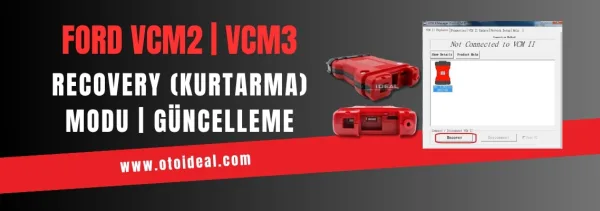
FORD VCM2 Update and Recovery Mode | Device Not Detected in IDS Program Issue
Ford VCM2 recovery and update: what to do when IDS does not see the device, and the order of the VCM2 recovery and firmware update steps.
Read More